One of the many recent discussions of flywheel physics sparked a realization about the design basis of a flywheel profile most elemental, and in hindsight, plainly obvious at least in theory. It involves concavity. So let's talk about concavity and ask the most basic question there is.
What the hell is the purpose of a concave flywheel profile, anyway?
(Be warned, theory ahead, but there are some cool things later on!)
Sunday, June 18, 2017

Wednesday, June 14, 2017
Brushless Inrunner AR Cage Continued, and Project T17
Where did I leave off with Project ACR? Here, I believe.


So the last image showed what was about to happen, more or less. Well, it happened. But not after a bit of bug hunting.


So the last image showed what was about to happen, more or less. Well, it happened. But not after a bit of bug hunting.
Saturday, June 3, 2017
Mini-Review Raytheon Waffle Dart
I received one sample clip of this dart from dkdavid721.

Tip diameter: 0.460" front, 0.490" rear
Foam OD: dart 1 0.488 - 0.502", dart 2 0.485 - 0.503"
Length: dart 1 2.892" (73.64mm), dart 2 2.875" (73.02mm)

For reference:

Tip diameter: 0.460" front, 0.490" rear
Foam OD: dart 1 0.488 - 0.502", dart 2 0.485 - 0.503"
Length: dart 1 2.892" (73.64mm), dart 2 2.875" (73.02mm)

For reference:
- Mengun Red, tip diameter 0.405 front/0.462 rear, foam OD 0.487 - 0.513", length 2.884
- Gen3 koosh (yellow foam), tip diameter 0.483, foam diameter 0.510 - 0.519", length 2.877
Chrono shots: T3.1, full length RS inner barrel (straight flute), Hooligan flywheels: 120.0, 129.8, 123.6, 125.1, 127.4, 120.1, 114.4, 123.1, 117.9, 123.5


Notes: A very, very accurate dart, easily killing the koosh hands down. These things are lasers with groups under 18" at 45 feet range and 120fps. The newer version of tip that Raytheon sells has a shorter core than the original waffle tip and is made of a slightly stiffer compound. Also, the tip gluing is improved over the "Ekind" era waffle dart.
Tip failures should not be an issue with these and flywheel performance and consistency is improved over the Gen 1 waffle dart. These shoot as clean as Mengun red. However, the foam is still small bore, coarse celled and not that great of quality and velocity retention is still a bit poor.
Verdict: Good stuff. I'm buying several cases of this dart right now. However, I do recommend using it with at least a modern SSS flywheel gun equipped with a high crush flywheel system and a short barrel.
Also, even Hooligans/other Artifactoids and similar class of flywheels (like Worker and CC Cyclone) in 43.5mm cages, which work well for fatter-foamed darts, may not give the correct crush ratio to be optimal on these, due to the small bore foam. They are worth a shot with a combination of same flywheels and a crush-boosting cage.
Saturday, May 20, 2017
Brushless Artifact Red Cage, Part 1
Project ACR: An exploration of the application of brushless motor technology to the Superstock Standard format.


Sunday, March 26, 2017
In which a point is made about game design being a game, and an argument is made that specials are here to stay
I've been experimenting with making Youtube videos - mostly to see if I can get a point across in less time than it would take me to write an equivalent text post. Other than my (hopefully not too) annoying voice, this one seems to have turned out fairly well:
This video has already been linked on reddit, so I'm posting it here mostly for the sake of completeness.
This video has already been linked on reddit, so I'm posting it here mostly for the sake of completeness.
Saturday, March 18, 2017
Metapocalypse Now: a long time coming HvZ Rant.
Starting posts is always hard, but let's drop the clutch on this motherfucker. Okay, you probably know Rob Lehr, the Thunderdome documentary dude. Maybe you have seen his rambling semi-coherent video, maybe not, but it is a good catalyst for this post.
Friday, September 23, 2016
Rivaloader Improvements, Combat Test, USF HvZ TM Footage and HIR Format Thoughts
Now that the basic design principle of the Rivaloader is established and proven, I have moved on to the initial refinements.
First change was to increase the impeller speed, at this stage by sticking a faster 380 motor from an old blower on the same gearbox. That pepped it up a bit. Second was this:

The angled feedneck is a preliminary shot at matching the exit path of balls more closely to the velocity they are being given in the raceway, reducing the tendency to bounce over the feedneck in the original.

The setup with this tall prototype assembly ends up making my current vertical feed gun way too awkward for combat, so I shot the V1 with the faster motor installed at this past Sunday's game. However, there was a slight improvement with this configuration to what I would call "nearly acceptable". I am going to reach for more and more extreme versions of this design that make the feedneck intersect closer and closer to tangentially with the raceway.
What idea this sparked is that if the anti-jam (rollover tolerant) clearance is maintained at the tightest pinchpoint in the system, any raceway design can be used. So this may get away from a flat sheet baseplate in the next iteration and instead have a descending feed path starting at, say, 0.75" from the impeller blade underside and then spiralling down and off at a low angle.
Other major targets for improvement are the gearboxes (I found something taller ratio and stronger for the V2) and the impeller blade count and profile which is currently the original crude 2 blade unit. And of course it needs a nice gigantic hopper, once the engine is squared away. Multiple cases of red and white Cornucopia V2 and paintball pods for reloading are on the way.
Pre-game I fabbed up a lid for my hopper:


This is the configuration I used: V1 Rivaloader body and impeller with faster motor, 60 round hopper, new lid. Stock Zeus cage and motor set and same old powerfeed from before, and a 1300mAh 3S Monolith. Getting around 13rps in this form and nominal velocity.

I won't bother with posting the shooting video of the setup because videos of shooting at nothing are boring. Instead, let's just see the combat footage, which leads me to my next subject. USF HvZ training mission footage is up on the youtube. Check out the playlist for the entire event, but here is most of the relevant shooty stuff in this one.
The development gun ran like clockwork and shredded zombies without a single issue. Outofdarts, I don't know why you are jamming, I still haven't had any malfunctions with this system. Well, aside from me shooting out my hopup...

David Kaye saw that it was torn almost completely through at the game. I got home, railed on it with what was left in the hopper and the tip of the nub went flying out the barrel. Whoops!


Classic fatigue failure, strange seeing it on rubber like that
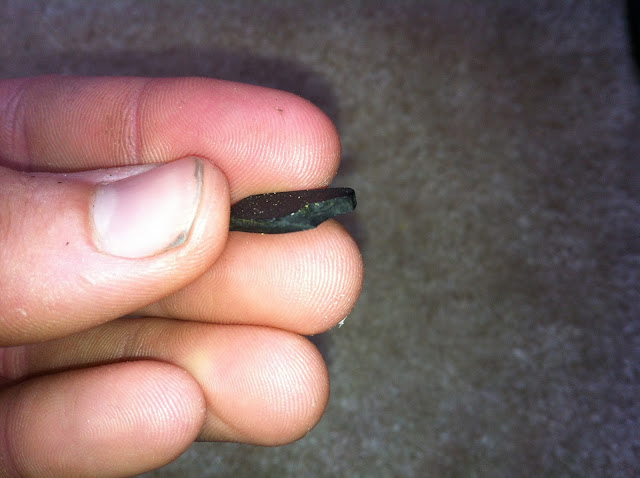
I may very well have had less range and accuracy that I should have from shooting through the broken nub all day. Oh well, I will slam a new inner barrel assembly in there today. I will use the old one to experiment with more durable aftermarket hop nubs because this may just be what happens when these things get run this hard and rack up so many rounds, this is a cheap part that comes in a fuckin toy after all. Fiber reinforced belting should do it, maybe a piece of a timing belt or flat belt. May also try making the hop adjustable.
Now, some observations about the HIR format.
So by now you have probably heard a ton of discussions about HIR. Sectional density, slow floating shots, dodgability, hopup dependence, being outranged by .50 cal opponents, plenty of noobs not understanding physics and thinking they can shoot them hundreds of feet at 400fps with a giant airgun, people who switch completely to them and extol their virtues, people who think they are crap...
I will say I really like them.
Are they ballistically the most optimal or competitive projectile within superstock safety caps? Hell no. .50 cal just stomps the crap out of them in terms of retained velocity hands down and with modern .50 cal hardware shooting those darts, HIR is flat outclassed with nothing to be done short of a significant mass increase (which hinges on the manufacturers to tool up and produce it, and the process to be able to make usable ammo at a higher mass). There is no debating that. Accuracy has been a HIR selling point, but Gen3 koosh is comparable and hits a lot harder and faster at range.
Furthermore, the other major problem with HIR relates to the design of practical primaries for the practical player. The .90 caliber ball is a very awkward dimension and just does not lend itself to magazine feed. The original Hasbro single-column mags from the 2015 line did not provide the desired 15-20 round minimum capacity and yet were very long. I applaud Hasbro for tackling this problem and arriving at the multiple-feed 40 round Khaos magazine, but these are the size of a textbook, and as of right now, the mags are still not available aside from the single mag that comes with the gun. Hence, the Khaos is nearly a moot point pending the solution of this issue.
HIR does NOT get along with bolts/breeches of any kind. Frankly, HIR guns that are not flywheel are inherently troublesome and inferior, because they always need a way to seal off the breech. By contrast I have never had any kind of stoppage with my old Zeus configurations nor my current hopper loaded unit, and most field issues I see with flywheel HIR guns are stock Zeuses with the crappy, slow-ass semi-auto trigger group. Which has a very weird looking form of bolt, but it is still mechanically a bolt, regardless. No wonder! HIR is practically made for flywheel and continuous-motion feed. It is a strange situation really, and not one friendly to the "I don't like flywheel" crowd at all. It just reinforces the niche, however.
And finally, even at .90", they get lost. HIRs bounce like mad, roll once they land, and will find every hiding place and escape route.
Now for the redeeming qualities:
Extreme durability! Here are some Hasbro HIRs I have been using for testing since the early days:

These have been shot many dozens of times, left out at fields and the yard at Site B and then found months later, stepped on and generally abused and ignored.

They show their history and some have serious surface wear, but they still feed fine and shoot great. The polyurethane foam is much more resilient than PE dart foam and due to both the material and the launcher design associated with ball ammo, there is MUCH less impact on performance as it wears and weathers than there is with PE foamed cylindrical darts. I lost track of how many times I have got into the subject of dart maintenance on reddit, but the gist of it is that for community groups and commercial fields that rent or otherwise supply .50 cal darts and/or gear, a concerted effort and constant expenditure is necessary to avoid giving players a terrible experience with crappy deteriorated ammo causing poor accuracy, inconsistency and malfunctions. This does not mean that .50 cal cannot be made to work, but in that type service, HIR and its durability and benign failure can be a huge benefit. While HIR cost is still around double that of a quality brand of .50 cal dart, HIRs in field/community pool use could last well over twice as long, and in sealed environments like indoor fields where ammo cannot escape, it makes a lot of sense. HIR is very carefree. Step on it, grab it from the ground and shoot it without worry.
HIR is great for bulk loaders, great for support and all-out OTT spam loadouts (compare to the gravity stickfeed Nitron and belt-fed .50 foam), great for abstract "sporting" hardware with no pretense of being the slightest bit milsim, and great for playing "sportlike" games. It is also inherently very safe and difficult to alter or cheat with, being that the entire projectile is made uniformly of one piece of molded foam. It will never replace .50 cal for me but I think it has a definite future. I am going to keep using it for sure.
First change was to increase the impeller speed, at this stage by sticking a faster 380 motor from an old blower on the same gearbox. That pepped it up a bit. Second was this:

The angled feedneck is a preliminary shot at matching the exit path of balls more closely to the velocity they are being given in the raceway, reducing the tendency to bounce over the feedneck in the original.

The setup with this tall prototype assembly ends up making my current vertical feed gun way too awkward for combat, so I shot the V1 with the faster motor installed at this past Sunday's game. However, there was a slight improvement with this configuration to what I would call "nearly acceptable". I am going to reach for more and more extreme versions of this design that make the feedneck intersect closer and closer to tangentially with the raceway.
What idea this sparked is that if the anti-jam (rollover tolerant) clearance is maintained at the tightest pinchpoint in the system, any raceway design can be used. So this may get away from a flat sheet baseplate in the next iteration and instead have a descending feed path starting at, say, 0.75" from the impeller blade underside and then spiralling down and off at a low angle.
Other major targets for improvement are the gearboxes (I found something taller ratio and stronger for the V2) and the impeller blade count and profile which is currently the original crude 2 blade unit. And of course it needs a nice gigantic hopper, once the engine is squared away. Multiple cases of red and white Cornucopia V2 and paintball pods for reloading are on the way.
Pre-game I fabbed up a lid for my hopper:


This is the configuration I used: V1 Rivaloader body and impeller with faster motor, 60 round hopper, new lid. Stock Zeus cage and motor set and same old powerfeed from before, and a 1300mAh 3S Monolith. Getting around 13rps in this form and nominal velocity.

I won't bother with posting the shooting video of the setup because videos of shooting at nothing are boring. Instead, let's just see the combat footage, which leads me to my next subject. USF HvZ training mission footage is up on the youtube. Check out the playlist for the entire event, but here is most of the relevant shooty stuff in this one.
The development gun ran like clockwork and shredded zombies without a single issue. Outofdarts, I don't know why you are jamming, I still haven't had any malfunctions with this system. Well, aside from me shooting out my hopup...

David Kaye saw that it was torn almost completely through at the game. I got home, railed on it with what was left in the hopper and the tip of the nub went flying out the barrel. Whoops!


Classic fatigue failure, strange seeing it on rubber like that

I may very well have had less range and accuracy that I should have from shooting through the broken nub all day. Oh well, I will slam a new inner barrel assembly in there today. I will use the old one to experiment with more durable aftermarket hop nubs because this may just be what happens when these things get run this hard and rack up so many rounds, this is a cheap part that comes in a fuckin toy after all. Fiber reinforced belting should do it, maybe a piece of a timing belt or flat belt. May also try making the hop adjustable.
Now, some observations about the HIR format.
 |
| Don't steal my HIRs |
I will say I really like them.
Are they ballistically the most optimal or competitive projectile within superstock safety caps? Hell no. .50 cal just stomps the crap out of them in terms of retained velocity hands down and with modern .50 cal hardware shooting those darts, HIR is flat outclassed with nothing to be done short of a significant mass increase (which hinges on the manufacturers to tool up and produce it, and the process to be able to make usable ammo at a higher mass). There is no debating that. Accuracy has been a HIR selling point, but Gen3 koosh is comparable and hits a lot harder and faster at range.
Furthermore, the other major problem with HIR relates to the design of practical primaries for the practical player. The .90 caliber ball is a very awkward dimension and just does not lend itself to magazine feed. The original Hasbro single-column mags from the 2015 line did not provide the desired 15-20 round minimum capacity and yet were very long. I applaud Hasbro for tackling this problem and arriving at the multiple-feed 40 round Khaos magazine, but these are the size of a textbook, and as of right now, the mags are still not available aside from the single mag that comes with the gun. Hence, the Khaos is nearly a moot point pending the solution of this issue.
HIR does NOT get along with bolts/breeches of any kind. Frankly, HIR guns that are not flywheel are inherently troublesome and inferior, because they always need a way to seal off the breech. By contrast I have never had any kind of stoppage with my old Zeus configurations nor my current hopper loaded unit, and most field issues I see with flywheel HIR guns are stock Zeuses with the crappy, slow-ass semi-auto trigger group. Which has a very weird looking form of bolt, but it is still mechanically a bolt, regardless. No wonder! HIR is practically made for flywheel and continuous-motion feed. It is a strange situation really, and not one friendly to the "I don't like flywheel" crowd at all. It just reinforces the niche, however.
And finally, even at .90", they get lost. HIRs bounce like mad, roll once they land, and will find every hiding place and escape route.
Now for the redeeming qualities:
Extreme durability! Here are some Hasbro HIRs I have been using for testing since the early days:

These have been shot many dozens of times, left out at fields and the yard at Site B and then found months later, stepped on and generally abused and ignored.

They show their history and some have serious surface wear, but they still feed fine and shoot great. The polyurethane foam is much more resilient than PE dart foam and due to both the material and the launcher design associated with ball ammo, there is MUCH less impact on performance as it wears and weathers than there is with PE foamed cylindrical darts. I lost track of how many times I have got into the subject of dart maintenance on reddit, but the gist of it is that for community groups and commercial fields that rent or otherwise supply .50 cal darts and/or gear, a concerted effort and constant expenditure is necessary to avoid giving players a terrible experience with crappy deteriorated ammo causing poor accuracy, inconsistency and malfunctions. This does not mean that .50 cal cannot be made to work, but in that type service, HIR and its durability and benign failure can be a huge benefit. While HIR cost is still around double that of a quality brand of .50 cal dart, HIRs in field/community pool use could last well over twice as long, and in sealed environments like indoor fields where ammo cannot escape, it makes a lot of sense. HIR is very carefree. Step on it, grab it from the ground and shoot it without worry.
HIR is great for bulk loaders, great for support and all-out OTT spam loadouts (compare to the gravity stickfeed Nitron and belt-fed .50 foam), great for abstract "sporting" hardware with no pretense of being the slightest bit milsim, and great for playing "sportlike" games. It is also inherently very safe and difficult to alter or cheat with, being that the entire projectile is made uniformly of one piece of molded foam. It will never replace .50 cal for me but I think it has a definite future. I am going to keep using it for sure.
Thursday, August 11, 2016
The Rival Revival: HIR Powered Hopper Development History.
Some of you remember this project of mine:

Oh man, where do I even begin... This was actively being developed about a year ago. I only recently happened across a cheap Zeus and bagged it and its cage, complete with flywheels and stock 360 motors, to replace the problematic parts in this from past experiments without spending much on it; and thus, I unfroze this thing.
At the time, Nerf Rival and its pioneering .90 caliber foamball format was very new, and the one question on everyone's mind involved hoppers and high-capacity bulk loading systems which the new spherical ammo begged for.
Airfeed, as popularized by outofdarts, Radiosilence187 and the "HIRricane" lineage, had not been invented/discovered yet. The focus was traditional paintball-style hoppers. Some prior art:
- Reddit user woodpiece converted a Zeus to fire .68 caliber Reballs (rubber reusable paintballs) using a gravity paintball hopper, a sweep pipe connecting the feedneck to the breech, and a powerfeed device made from half a Hasbro .50 cal flywheel cage.
- Mr. BadWrench (Donald Wester on Facebrick) attached a gravity hopper made from a plastic container or funnel to a semi-auto Zeus.
Wednesday, August 3, 2016
Mailbag: Artifact "Red" (Parallel Axis) Milled Flywheel Cage
Recently there has been some buzz about Artifact's new superstock flywheel products and I have been super excited to see what's up with this low cost, high quality stuff. This was the first of the line to show up in a listing, so it was my first order to arrive.
I used BuyChina here and this was the timeframe:
Order placed July 5.
Shipped July 13.
Arrived July 25.
Fairly good, really. I recently placed another order which contains sets of all three models of Artifact flywheels and one of the canted axis (Super-E, the gold anodized one) cage to complete what I need to put the Artifact cage and flywheel products through their paces.

These cages are CNC machined aluminum, much like the DRS Performance product you probably know about. They are one-piece and mount motors with screws as with all other hobby market cages.
The two cages available now are superstock standard, and intended to fit all Stryfe/Rapidstrike cage applications.
Here I have installed a pair of Banshee-130. I didn't happen to use the motor screws that come with the cage, I had some on hand that came with XP180 motors. The stock ones may be too short for certain motor cans such as the MTB Hellcat.

Test fitting in a Stryfe receiver.
One observation here is that the mounting bosses don't locate the cage with all that much precision, there is some play. Other cages fit the bosses like dowel pins and that sets the alignment. We will see what happens with that shortly. One positive of the clearance is that the cause of alignment issues is often the receiver being itself out of tolerance being that it's usually a crappy toy part. We can use that clearance to adjust and shim out problems. However, I am concerned about the potential to NEED shims or adjustment of every build even with a known good receiver and furthermore the potential for a drop or hard hit to knock the alignment out.

Inner barrel length required for these will be different (longer) from a Hasbro cage if you are switching from one of those. You will have to replace your old inner barrel with a new longer one. There is a counterbore about 1/8" deep at the front of the cage to locate the inner barrel.

These parallel axis cages accept standard-design flywheels, such as common Hasbro cylindricals, Workers, BlasterParts, and Artifact's own. This is unlike the DRS Performance cages which use a different center distance and smaller pitch diameter deep-concave flywheels in order to fit the flywheel rims within the standard cage envelope.
However, the Super-E cages are reputed to not accept certain flywheels, notably Artifact's standard flywheels which are of a mild-concave design. This is likely just a clearance issue. Artifact has specific flywheels for that cage, which are one of those I have on order (they appear to be a more heavily truncated version of the same mild-concave design). Worker flywheels are said to fit both Artifact cage models.

The inside surface of the mount sockets is around 0.5mm farther inward toward the access side versus a Hasbro cage. No caliper so I can't get at the mount socket depth or relative motor position, but I suspect the motor is pulled slightly farther inward here and this is likely why Artifact flywheels have zero hub protrusion on the inside unlike most other designs. A bit more clearance for the bearing housing there.

Now this is one of the more interesting bits of the design. The "red" cage, at least, takes a very laissez-faire approach to round control. That bore you see is the same diameter as an inner barrel! Even a Hasbro cage has tighter guide rails, although it does not present a parallel guide profile prior to and during flywheel contact, and this design does (much like other tubular guide systems and like my main Tacmod's prototype guide rail system).
We will see what happens with this concept when I test it, first with cylindrical flywheels and then with Artifact's concaves. Conventional wisdom is that the lack of round positioning will cause havoc with concave systems, but no flywheel profile like Artifact's has been extensively tested yet; the best parallel to them is the BlasterParts flywheel, which has unsatisfactory crush and doesn't make much velocity but otherwise is acceptable and consistent on Hasbro cages.
You can also see the feed ramp in here which is just a nice big chamfer. Simple, should do well enough.
 |
| Motors NOT included. |
I used BuyChina here and this was the timeframe:
Order placed July 5.
Shipped July 13.
Arrived July 25.
Fairly good, really. I recently placed another order which contains sets of all three models of Artifact flywheels and one of the canted axis (Super-E, the gold anodized one) cage to complete what I need to put the Artifact cage and flywheel products through their paces.

These cages are CNC machined aluminum, much like the DRS Performance product you probably know about. They are one-piece and mount motors with screws as with all other hobby market cages.
The two cages available now are superstock standard, and intended to fit all Stryfe/Rapidstrike cage applications.
Here I have installed a pair of Banshee-130. I didn't happen to use the motor screws that come with the cage, I had some on hand that came with XP180 motors. The stock ones may be too short for certain motor cans such as the MTB Hellcat.

Test fitting in a Stryfe receiver.
One observation here is that the mounting bosses don't locate the cage with all that much precision, there is some play. Other cages fit the bosses like dowel pins and that sets the alignment. We will see what happens with that shortly. One positive of the clearance is that the cause of alignment issues is often the receiver being itself out of tolerance being that it's usually a crappy toy part. We can use that clearance to adjust and shim out problems. However, I am concerned about the potential to NEED shims or adjustment of every build even with a known good receiver and furthermore the potential for a drop or hard hit to knock the alignment out.

Inner barrel length required for these will be different (longer) from a Hasbro cage if you are switching from one of those. You will have to replace your old inner barrel with a new longer one. There is a counterbore about 1/8" deep at the front of the cage to locate the inner barrel.

These parallel axis cages accept standard-design flywheels, such as common Hasbro cylindricals, Workers, BlasterParts, and Artifact's own. This is unlike the DRS Performance cages which use a different center distance and smaller pitch diameter deep-concave flywheels in order to fit the flywheel rims within the standard cage envelope.
However, the Super-E cages are reputed to not accept certain flywheels, notably Artifact's standard flywheels which are of a mild-concave design. This is likely just a clearance issue. Artifact has specific flywheels for that cage, which are one of those I have on order (they appear to be a more heavily truncated version of the same mild-concave design). Worker flywheels are said to fit both Artifact cage models.

The inside surface of the mount sockets is around 0.5mm farther inward toward the access side versus a Hasbro cage. No caliper so I can't get at the mount socket depth or relative motor position, but I suspect the motor is pulled slightly farther inward here and this is likely why Artifact flywheels have zero hub protrusion on the inside unlike most other designs. A bit more clearance for the bearing housing there.

Now this is one of the more interesting bits of the design. The "red" cage, at least, takes a very laissez-faire approach to round control. That bore you see is the same diameter as an inner barrel! Even a Hasbro cage has tighter guide rails, although it does not present a parallel guide profile prior to and during flywheel contact, and this design does (much like other tubular guide systems and like my main Tacmod's prototype guide rail system).
We will see what happens with this concept when I test it, first with cylindrical flywheels and then with Artifact's concaves. Conventional wisdom is that the lack of round positioning will cause havoc with concave systems, but no flywheel profile like Artifact's has been extensively tested yet; the best parallel to them is the BlasterParts flywheel, which has unsatisfactory crush and doesn't make much velocity but otherwise is acceptable and consistent on Hasbro cages.
You can also see the feed ramp in here which is just a nice big chamfer. Simple, should do well enough.
FK130PH-2460 Motor Failure
A quick tech observation post: This -2460 was one of the pair driving the flywheels in our scout's pistol Stryfe during NvZ'16. It had previously given reliable service through several games. Coming into the final mission briefing, the user discovered a malfunction with a dart left between the flywheels, cleared it, and then found the dead motor. The Vulture in my backpack was promptly issued.

On gun teardown the offending motor was found to turn freely and smell of burnt magnet wire. The motor was then removed and disassembled and the cause was found to be a winding burnout as expected. You can see melted varnish on 2 poles.

Commutator, brushes, and winding terminations were all intact and the windings had not structurally failed.
The battery at the time of failure was a 2S 1600mAh Monolith.
User was questioned as to what immediately preceded failure and noted that he had been running to a safezone and then noticed that his flywheels were locked up. I could not get a clear idea of how long the motor may have been stalled. It is possible that this is simply a sustained stall failure from a malfunction followed by accidental activation while running, but also possible that the only stall occurred when the problem was discovered and the failure had been ongoing up to that point.

Based on what happened here, the bright (clear varnish) color of the undamaged wire, and the failure mode (melting at what must be a low temperature from the lack of carbonization, compare to the appearance of other high quality motors' burnouts, example being the Mabuchi -3240) I have my suspicions that these cheap motors are wound with wire of insufficient insulation temperature class and are vulnerable to thermal damage from momentary stalls and/or sustained hard use.
I am planning to preemptively take these out of the remaining Tacmod in the squad that is equipped with them as soon as the chance presents itself to do so. Suspicions like that are not worth playing with.
Subscribe to:
Posts (Atom)