A few years ago, I wrote a post exploring the possibility of stacking flywheel cages to achieve higher velocities. This was written mostly from a theoretical perspective. At the time, there was very little actual data on how much velocity could be achieved with such systems - very few people had made multi-stage flywheel systems, and those had a pesudobarrel in the middle which dropped the velocities that could be attained well below the theoretical maximum.
As you might recall, the simple model that I used predicted that the glass ceiling velocity of such a system would be equal to the square root of the number of flywheel stages times the glass ceiling velocity of a single stage - and that the spacing between flywheels would have no effect on this velocity.
498 Nerf has obtained some very interesting results from a two-stage flywheel system with varying spacing between the stages. A video explaining these results, along with links to the chrono results, can be found here.
In summary, he obtained:
140 fps with the flywheel stages jammed as close as possible together
155 fps with the flywheel stages moved a bit further apart
165 fps with the flywheel stages spaced such that a dart enters one just as it leaves the other
All of these results were obtained with the same motors and voltage.
This last result is pretty close to what we should expect based on my model - but the variation in velocity with flywheel spacing demands explanation. I can say that the explanation that 498 proposes is either incorrect or incomplete. While increasing the spacing between flywheels will result in the dart spending a greater total time in contact with at least one stage, it will also decrease the time that the dart spends in contact with both stages - and, mathematically, these effects should cancel.
Kysan 16180 motors running on 4S have a no-load speed of 22,200 RPM, and rhinos running on the same voltage have a no-load speed of 44,400 RPM, if we neglect energy lost due to air resistance on the flywheels assume a nominal voltage for the battery. These are greater by a comfortable margin than my calculated lower bounds on the critical RPM for each flywheel stage of 20,200 and 28,500 RPM for the first and second stage respectively. So, the numbers check out - it looks like 498's multi-stage flywheel system is supercritical, or at least pretty close.
However, the first flywheel stage has a free-running RPM that is less than the second-stage critical RPM - and I think that this is what explains the drop in velocity when the flywheels are spaced closely together. When the flywheels are spaced close together, the dart is accelerated by the second stage while it is still in contact with the first stage - and it is accelerated beyond the flywheel surface speed of the first stage. This results in the dart dragging the flywheels forwards instead of the flywheels dragging the dart forwards - hence the drop in velocity.
So: while these results may at first glance appear to contradict my model, they actually support it on closer examination. Given that the velocity attainable with a single flywheel stage is already pretty close to the maximum velocity that people outside of NIC wars usually want, this is largely just a matter of curiosity - but it's still nice to finally see some experimental verification.
Update: 498 has done some further experimentation, which provides more confirmation - his original setup, which had the motor cages right next to each other, yielded a higher velocity with first-stage motors with a higher RPM (Kysan 17114, which turn at about 30k RPM at 4S), indicating that his original first-stage motors were not supercritical.
Interestingly, he obtained an average of 152 or 160 fps (depending on whether a few shots, believed to be misread, are discarded), which is still less than the 165 fps that we would expect. Perhaps 30k RPM is still not quite supercritical - or perhaps the difference of ~5 fps in the average results is just an artifact of small sample sizes. Either way, these results strongly suggest that the 'dragging' effect is real.
After some research, I think I can conclude quite definitely that what I have is not even a proper 808 type 18 V2 camera, it is a clone of some variety.
My camera does not have the same PCB layout as the known 18 cameras. The battery did not have a connector from the factory. It ignores the s1config.bin file which HETAI (the manufacturer of the real 18) describes in their documentation, and if its firmware even HAS the usual configuration options, I do not know what the filename or format are to use them. It reads the date/time and the timestamp on/off switch from a "time.TXT" file which is described in the user manual included. This is not an 18 camera feature, and is more common among older types of 808.
Nor does my camera pay any attention to the FWDVCH.bin file for firmware reflashing (I tried in an effort to resolve my bugs). Probably a good thing, because I don't know what the hell this hardware actually is, and it might not be compatible with 18 camera firmware.
The files this produces are 1920x1080, not 1280x720 as the real 18 should generate. These are almost certainly scaled from something (960x540? 1280x720?), I am just not sure what yet. The filenames are PICTnnnn.AVI which is once again unknown among the 18 cameras (should be PTDCnnnn.AVI or DCAMnnnn.AVI if I recall correctly).
The camera does not take still images if the shutter button is pressed either on standby or during recording. Another redflag.
Bugs
Shortly after receiving this I discovered a number of issues:
Occasionally, the camera starts itself back up repeatedly after being powered down manually or automatically.
The camera often will not power back up after shutting down once. The battery must be disconnected or the reset switch pressed.
Huge audio and video noise when battery voltage goes to around 3.6V
File corruption.
I want to expand on the last: The camera splits files at 10 minutes like most 808 cameras do. However, on this unit, when the first file gets near 10 minutes, it seems to reliably have missing bits and audio sync problems. Furthermore these AVI files are structurally screwed up in some way and I am unsure about my success editing them with my present tools.
I tried to dashcam my drive to work several times and the files (all <10min after startup) were mangled.
The upshot was that successive files, including one that ran the full 10 minutes and overflowed into another, appear to be OK - so I should be able to limp this along by throwing away 10 minutes of dummy video at the start.
Research is ongoing and I hope I eventually end up with a fully working and configurable firmware in this thing.
Mods
The battery was an issue that needed addressing, of course. The little stock lipo was going to die quickly even if it worked. It also didn't seem to be in that great of health and wasn't holding a charge, who would have figured for a no-brand Chinese battery. So I did what I do best: Put a pack on it.
I had 2 of these Panasonic NCR18650B (3400mAh NCA) which have had their positive terminals smashed in from the defective contact design of Convoy flashlights (fixed in my light and my father's light by a mod). I didn't trust these to make reliable contact in the lights anymore and they were gathering dust so I welded tabs on one, wired and terminated with a Deans connector, and bam I have a mega ultra super high capacity battery for the 808, at a whopping 850% improvement over stock capacity. The camera itself lost its lipo and protection circuit* and gained a cable and a male Deans.
(* I didn't trust the protection circuit not to cause trouble, and the camera shuts down well ahead of the 2.5V cutoff voltage of the NCR cell, not to mention even the biggest supported card would fill up well before the battery was flat. So far I have run it about an hour equating to 8.5GB of files and the battery is only down to 4.06V.)
The way I run this (battery not quite properly secured in the hasty image):
It works out very well.
Stand by while I try to get some test footage of me driving up on youtube.
Edit 04-08-16: I seem to have discovered that this camera has, of all things, overtemp shutdown. Twice I tried to record dashcam videos with it today, and both times it cut out within a few minutes. I guess it didn't like being in a black plastic case attached to a black dashboard in the Florida sun. For how many things are missing or broken with this cam, that is a weird feature to have there and working. Cool?
As of right now it is recording continuously sitting indoors and will be doing so until the card is full, hopefully that is in fact what happened, and it didn't just randomly stop.
Also, a hunch that only the first file is corrupted no matter how LONG the first file is; so perhaps booting up and recording a 5 second dummy clip before filming anything will stop the initial wrecked AVI.
Conclusion
One, do not buy this camera. Do NOT buy this camera. Just don't. Feel free to buy an 808, but do yourself a favor and buy a genuine type 16 D-lens at around $40 - or even a genuine 18V2 from HETAI's ebay. This one I bought is a shitty clone and I regret buying it and am still concerned over whether I will be able to limp it along and get game footage out of it or if it will just fail miserably. Oh, and consider a Mobius rather than an 808, they are much more of a "real" piece of equipment. As soon as I can I will probably buy either a 16 or a Mobius.
Two, the hat mount works, and so does the battery.
Edit 04-15-16: A major update.
The planned combat test
was a miserable failure and every single file generated of the entire
TBNC woods game was junk. It's a shame too, although the game was a bit
dysfunctional, some good moments and some chatting with players happened
that would have made for a good first video.
It seems my hypothesis of first file corruption was false, something more entropic and devilish is at play here.
However I may have stumbled upon the answers from an unexpected
direction, in the process of going through motions ruling out easy
causes my attention turned to the flash card. A bit of digging turns up a
lot
about junk flash and junk SD cards that are frauds or don't meet specs.
Great, I bought a cheapo "Infinitive" brand card, cheapskate I am.
So
how do I verify SD card operation and performance? While researching
that, I come across something from the SD group itself about specific
low level formatting to ensure performance. Hmm, well when I started
having power management issues, I promptly used newfs_msdos on my SD
card for the same reasons, eliminate something wrong with the filesystem
or fragmenting or whatever as a possible cause. That of course didn't
achieve anything, but I didn't think anything of it at the time, because
FAT is FAT is FAT, right? I reformatted right before the game and that
was the worst it had ever been.
And now that I think of it, reformatting may have started my trouble with munched AVIs and missing data.
Now I have formatted my card with the "official" SDFormatter
utility, and went through a few tests mounted on the dash of the suzuki.
The files weren't mangled. All of them played, none of them was
frame drop central, none of them had unsync'd audio and they obviously
weren't (file length versus video runtime) missing huge data like
before.
I am also keeping note of the battery voltage being near 3.8V at
the time of this observation, in case I have a voltage related issue.
Fingers crossed that I managed to get a gremlin by the tail this
time, because damn, the little camera works well when it works. I like
it, I like it a lot. Even did some night driving with it and the footage
wasn't a black abyss like some dashcam videos.
I have been looking to film gameplay for years. The trouble is, I am not going to spend $300 on a GoPro. That's a used transmission for my Suzuki, or a high-end superstock gun like a Tacmod, or a HPA rig - I am not spending that on a camera.
What I wanted was something as small and cheap as possible with a wide angle lens and acceptable resolution. Bonus points for no head straps.
I came across these 808 keychain cameras from the RC community and finally just bought one:
$29.12 shipped on ebay. This seems to be a type 18 with a wide angle lens assembly, a version I have not seen documented. It also doesn't use the same configuration file as the 18 camera people have seen. Still trying to figure that out so I can get some better settings.
You get the camera, a manual in Chinese and broken English, and the nonstandard USB cable. You must supply your own microSD card.
This thing is literally the size of a car remote lock keyfob and just as light.
With velcro:
And here's where this is going:
Tested and works great, not noticeable, doesn't make my hat fall off, not in my vision, perfectly aimed. No head straps, no mounts, no turning around my hat like basicnerf for a gopro.
The big issue with 808 cameras is that they are majorly janky. They can do the job, but the hardware is cheap, poorly assembled and usually includes low quality no-brand parts. The firmware can be buggy and half-baked. You can't expect the reliability of a GoPro.
I did already encounter some strange behavior (continually turning itself back on whenever a card was inserted) and lockups that seem to have self-resolved by simply letting it run and shut down automatically on its own, resulting in continued normal function. You have to get to know your 808 model and its quirks and how to dodge them.
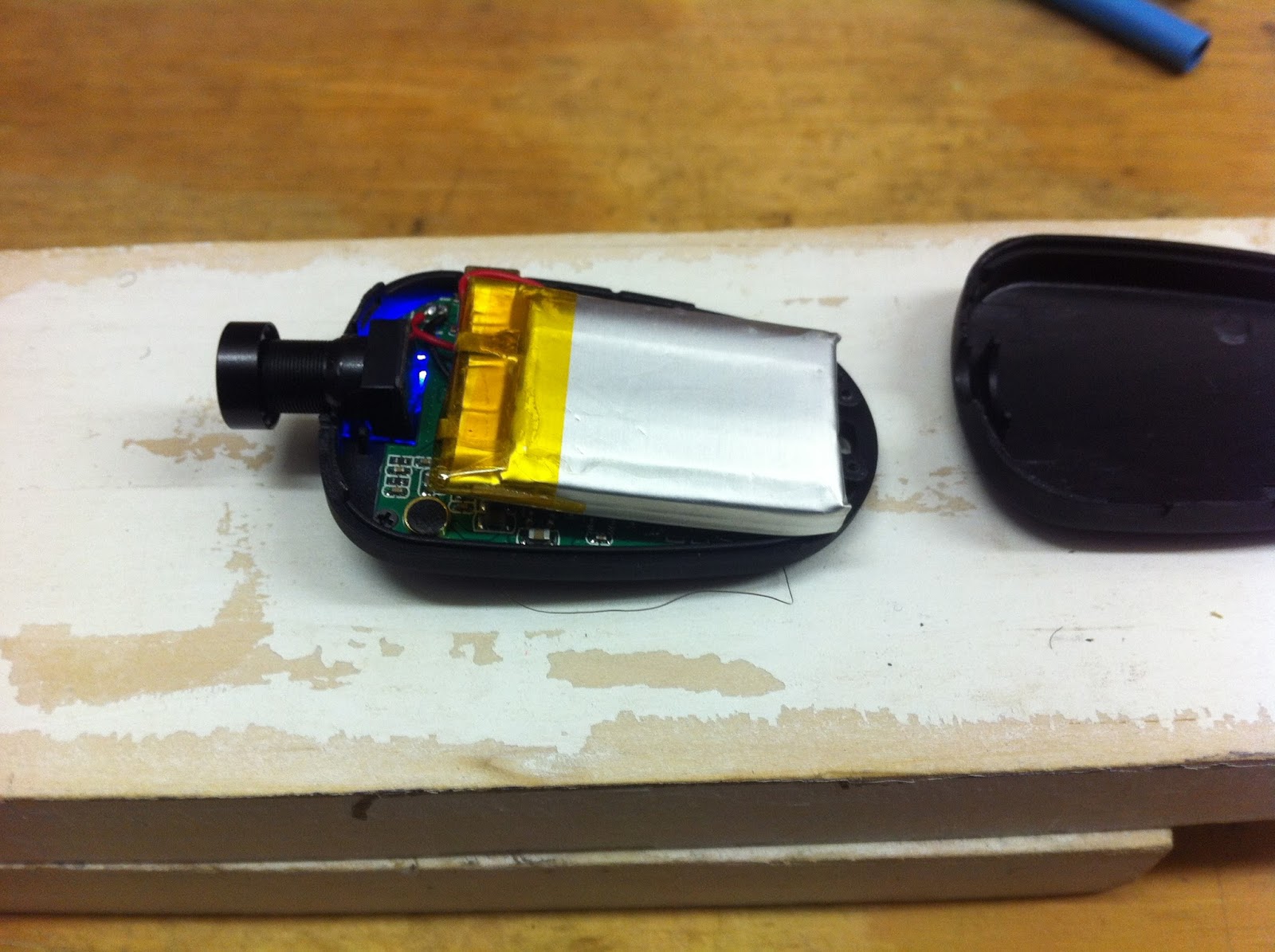
When I had this open for inspection
Battery is a 400mAh lipo cell, that will need to be addressed before NvZ. In the meantime I may just strap my Miller single 18650 powerbank/charger to the back of my hat with a USB cable and a NCR18650B cell, if it works I will just keep the little lipo in there.
The video from this is decent. A bit noisy and artifactey as is the audio, but the lens is not bad at all, and it is 1280x720. Footage and more technical matters in the next post, and this setup should get field time and a youtube post next Saturday at TBNC.
Spin stabilization is one of the ways that the accuracy of Nerf darts can be improved. A spinning dart that would otherwise curve in flight - which happens due to damage or imperfect manufacturing tolerances - will instead travel in a corkscrew. The curvature of the dart's flight path is averaged out, and the overall path of the dart is a straight line.
Dr Snikkas' flywheel cages are a well-known way to put spin on a dart while firing it, and they do seem to improve the accuracy of people's blasters tremendously. The draugr team has been working on developing a mass-manufacturable flywheel cage that does the same, and, we've discovered something odd: spin stabilized darts whirlybird more. (A whirlybird is a complete destabilization of a dart characterized by the dart spinning rapidly like a pinwheel. A whirlybird can turn a shot that should have gone 100 feet into one that lands at your feet.) Sometimes a lot more: one of the test cages causes koosh darts to whirlybird almost all of the time.
Here are my (largely speculative) thoughts on why.
Edit: There was a mistake in my math in the first version of this post - this is what I get for working in a hurry and not double-checking. It's fixed now.
This document is intended as a reference for anyone who needs to decide what modifications to Nerf blasters (and similar toys from other brands) to permit in their game, with a focus on games of HvZ played on campuses. The purpose of this guide is to give people the knowledge that they need to make safe decisions without being overly restrictive. It was originally supposed to be short and concise, but it grew over time into, well, this. Safety is important, so I think it's worth taking the time to read. This may be of use to both moderators, who make the details of and implement a game's rules, and campus officials, who have the final say on what is permissible.
I've added pictures in an attempt to make this a little less wall-of-text-ish and to break up the sections; these images are from Steph Smith's pictures from the University of Waterloo's first invitational, this imgur album, Oklahoma State University HvZ Facebook page, more from the same facebook page, and toyland.gizmodo.com. All of the images you see here have been edited (trimmed and resized) by myself.
EDIT: Almost immediately after publishing this post, a conversation started on reddit regarding the use and safety of Chinese LiCo batteries such as Trustfires - which has been a matter of some controversy over the years in the Nerf and other hobby electronics communities. I may have been overly generous in my assessment of the safety of these batteries, so I've edited the post to correct this.
This Zeus suddenly gave up the ghost when I was testing it last weekend, and this was the cause: a poorly-made solder join on the wire leading directly from the batteries to the motors had come loose.
The lemon lotto is beginning to feel a lot more like lemon Russian roulette; loose wires and misaligned parts are starting to feel almost routine. Poor QC is a minor annoyance to people with screwdrivers and soldering irons, but to the average consumer, this would have been a killer problem - especially if this had come loose during a game.
I've heard of other nerfers having similar problems with their Zeuses. This is no good. Somebody needs to fix their shit and fix it yesterday.
Testing has resumed as of last weekend, with no further problems.
Last time I posted about my Zeus, it was still semi-auto. Shortly after, I decided to change that, because I am strongly dissatisfied with the stock trigger's heavy pull and unreliability at higher ROF. IMO, something else needs to be done or developed aside from the standard Zeus if you want to use Rival automatics as a general-purpose (semi-auto or up to 15rps full auto with precise controllability, in my book) primary.
So my Zeus is now converted to uncontrolled feed. While it isn't the most practical with 25+ rps on a 12 round mag and awkward reload, the trigger is nice, and it is awesome.
There are 4 changes to make in order to get this functionality:
* Remove the ram lever and its torsion spring.
* Remove the rear gate and its shaft and torsion spring.
* Grind out the detent on the right feed housing half. Visible at front inside the feed path
* Grind out the detent on the front gate (the thin area above the semicircular curve). You want this gate to match the feed path seamlessly when fully open.
After doing so you will have screaming fast full auto - take a loaded mag, open the detent by hand, see the balls shoot out? That fast, except going downrange at a hundred odd fps. It's a great special weapon. Unfortunately, I can't think up a good selective fire or 2-stage trigger strategy using the stock parts.
Motor Upgrades
EDIT: I guess I forgot to update this, but my advice is to avoid straight motor swaps to anything higher torque than the stock 360 on these flywheels. They will NOT hold up to any more torque with the stock hubs. This setup hammered out one of the shaft bores in the flywheel about a month later. If you want to replace, fix or upgrade motors for these stock flywheels, look into brushless outrunners.
The search for good Zeus motors has been ongoing, and thanks to /u/farmcoffee on Reddit (member of the Draugr team) I received a free pair of this 0.47mm/35 turn 390 motor which was my first stab at it.
Specs on this are sparse as with most Chinese motors, but what is specified is 21000RPM@11.1V giving a kv of 1892 - fairly low for a 35 turn wind, but such is the expectation for a long armature with this sort of aspect ratio like the 390 "stretch" motor. You can also see this with 130 and 180 motors and their turn count versus kv.
I did encounter a snag. I was sent two motors obviously of different batches. One had stronger magnets and different color leads, and definitely revved slower as is expected from the magnets. Not exactly promising for prospective buyers of these for Zeus installs. These motors, however, have external flux rings - a steel sleeve on the outside of the can, to provide an additional magnetic path. These are removable and optional, and removing them is equivalent to weakening the magnets - adding speed, reducing stall torque slightly, and reshaping the torque curve as expected from these changes; so I ended up removing the ring from the slower motor, cutting it in half and putting it back on and bam, perfect speed match. Even with the flywheel load and the imbalance of the stock Zeus flies, they match about as well as any .50 cal gun ever would - Not shabby at all.
Stock Motors
This is also the first time I (or anyone?) has pulled the stock motors from a Zeus:
Once again confirming 360. Appears to be a Johnson clone. I don't think Hasbro ever uses genuine motors, it's all Chinese generics except those SMCs in the barricade. Also we have 24000rpm@9.6V printed on the can, and this gives a kv of 2500.
The 3160 wind is rather weird to me because it seems to be deliberately suboptimal copper fill. Note that a common AEG motor (Stampede, Swarmfire, Vulcan) is a Mabuchi clone RS360PH-3560 meaning the standard 300 series armature stack can take at least 0.35mm wire at 60 turns. In any case it is unfortunate that this motor is wound this way, although it works fine it could have had more guts with 0.35mm wire. Was this something to do with current and the C cells perhaps?
The shaft is 2.3mm (of course), 8mm protrusion from the bearing and a total stickout of 11mm from the mounting surface. It has the typical rolled splines for extra grip that a lot of 300 series shafts have. Doesn't seem that critical, the flywheels install super tight. This however is a shorter shaft than I expected. That is good, makes finding suitable motors easier as virtually ALL of the 300 series motors in existence will mount this flywheel properly.
Mod wise on the gun:
* The Zeus has rubber sleeve style mounts. Those familar with Stampede gearboxes will remember them. I had to trim about 1/4" off the top edge of mine to clear the flux rings on the 390s which needed to stay since I matched my motors by modding them.
* The stock hold-down brackets are used with longer screws. Be careful not to overtorque and break/bend the bracket since it doesn't seat against anything now. FYI, mounting the motors with screws into the can is NOT possible with the stock flywheels because the flywheel web runs SUPER close to the mount socket surface. Unless you countersunk the screw perfectly (which might make it weak) you need to clamp your motors into the socket from the outside. Similarly, you need either the stock rubber or a shim between the can and the bottom of the mount socket. The bearing snout hole in the socket will align the motors without the rubber, but the bearing snout will stick out too far into the inside of the cage and hit the flywheel.
* Normal clearance hole in the left shell.
* Shafts zipped to length after installation. Necessary to clear some stuff, BTW.
As an update, here is what I have done endbell cover wise:
And a little fix for the nasty sharp edge underneath as well. No paint yet.
Some other stuff:
* Flywheel installation depth is with the vertex of the V-grooved flywheel surface set just below the edge of the cage.
* You can probably remove these flywheels with a proper puller, but the easiest method for most is to suspend the cage with the motor hanging free and the flywheel sitting against the mount socket, and drive the motor shaft through with a punch smaller than 2.3mm (I used an old 130 armature).
* I found some evidence of contact of the flywheels with the cage: OD of mount socket (due to mold flash inside the fly that I removed) and face of mount socket due to install depth. This was all factory. If something seems to have friction or make a funny noise in a zeus, investigate it, there is very little clearance in these things and rubbing flywheels is a possibility.
* Pinion removal on larger motors (if you receive or scavenge a motor with a pinion on it) - use proper puller or lock pinion in vise and drive shaft through with <2.3mm punch. Don't pry against the can. You can do that with little motor stuff, not these.
Results
As I expected, these motors wanted 4S, so I am using the same 4 cell pack I was thrashing my stock motors on. By the numbers that is 28000RPM unloaded - compare to stock motors on 3S at 27750RPM unloaded (and smaller in comparison to the static load). Chrono data incoming but it shoots nominally.
Handling of high ROF is definitely improved, I haven't seen a visible shootdown problem yet. It definitely doesn't get droopy and inaccurate on the end of a mag dump like the stocks did.
Response is improved as well.
Speed match is improved substantially.
Stall torque is now sufficient to not be jammable by feeding a ball into stopped flywheels. The 390 motors have enough grunt to force through even the densest Rival ball from a standstill, and if you are familiar with how much crush the Zeus cage has and how damn hard it is to manually push the balls through the flywheels that is seriously impressive. The brushes aren't even broken in yet and the battery is half dead! The stock 360s didn't have a chance of recovering from that.
It is nice to be able to pin numbers on things for sure now that we have stock motor wind and kv data. Aim for 28000+ rpm and as much torque as possible.
I think next I have to explore the RS380SH-4535 and -4045 and similar winds. It is a much more common motor, and genuine Mabuchis are readily available (a good thing, so you don't end up like me hacking around with flux rings or getting lemons of sketchy Chinese motors); and also a bit shorter than the 390, simplifying the mount and cover mods.
In the end though, I think the stock motors are absolutely fine. If you are only shooting semi-auto, there is not one reason to replace them. Just wire properly and run 3S and you are good to go. Couldn't be easier to understand, and it's a nice change from the little fiddly 130s and shitty metal brushes that you have to confront in a stock .50 cal flywheeler.
I received a few comments from someone who decided to test out these Nichibo -3240 motors that Zinky86 on ebay was "able to get in" (http://www.ebay.com/itm/121624679840)...
Well, that's conclusive. 2 separate reports. I have not received that set from meishel to test but no need now.
I don't know what it is about the FK180SH-3240 that makes it so attractive for lowballers to slam metal brushes in! Hell, even the China clone variety FK motors have proper carbon brushes, and seriously, if you look at a 3240 armature and think "That will work with metal brushes for more than 5 minutes" you're an idiot, there is NO way that can have a legitimate purpose.
What's more is that the designation "FK" is a LIE. "K" specifies carbon brushes. It's very unambiguous, go look at the Mabuchi website. To put "FK" on a metal brush motor is misrepresenting the product. Same with Kysan Electronics - the Draugr team checked already and until we asked specifically they had the damn thing labeled as an FK with not a peep about metal brushes, and the specs were ripped from Mabuchi's datasheet on the real motor.
This is what Zinky86 had to say about the Nichibo -3240 motor:
This does not reflect positively on Zinky86, nor Nichibo, at all. I am going to give Zinky the benefit of the doubt and assume he was sold this motor believing it to be a clone from a reliable and experienced manufacturer, but I am still disappointed that the problem was not caught until members of our hobby bought fraudulent product.
Lakeland TRU: Nerf "Super Soaker" squirt guns. No, seriously. Fancier, beefier dimestore water guns. Zipfire - has this been spotted yet? Does anyone care?
Circa 2010-2013 Nerfsoakers are now getting knocked off. Well doesn't THAT look familiar.
And a Modulus unceremoniously thrown on the floor with a Sonic Fire Strongarm and a NOS pack of XLR ammo. I didn't do it...